
the psycho cat on an HP Mini with Ubuntu
Just Beginning
Introduction
Read this first before you try Ubuntu*
Which Ubuntu to pick?
Getting Ubuntu
Making a bootable USB of Ubuntu
Ubuntu inside Windows
Dual-boot with Windows
Install Desktop CD Ubuntu
Modest Specs
Install Software
Security in Ubuntu
Where's the Terminal?
Password in Terminal
Next Steps
Install Proprietary Drivers
Mount Windows
Install Proprietary Plugins
Finding iTunes Alternatives
Use Wine
Beyond the Basics
Backing up Ubuntu
Upgrade Ubuntu*
Change boot menu
Playing Around
Unity to classic Gnome
Unity Gnome/KDE Plasma Comparison
Install KDE
Install XFCE
Pure Ubuntu
Pure Kubuntu
Pure Xubuntu
Pure Lubuntu
Troubleshooting
Can't sudo
Graphical sudo
Forgot password
* Off-site link
Cheap Plugs
If you've found these tutorials useful, please consider donating a small amount to one of my favorite non-profits/charities. Every little bit helps.
You may also want to consider donating directly to the Ubuntu project.
Mounting Linux Partitions in Ubuntu

This work is licensed under a Creative Commons Attribution-ShareAlike 3.0 Unported License.
Warning: The tutorial on this page is for an internal drive that will serve as an extra data partition. If you would like to mount a separate drive or partition as /home instead, you want a different tutorial.
First you have to determine what the partition is called and what filesystem it is. One quick way to do it if you know what filesystem you formatted the drive as (Ext3, for example) is to just type the terminal command
Here's how it could come out:
255 heads, 63 sectors/track, 1044 cylinders
Units = cylinders of 16065 * 512 = 8225280 bytes
Sector size (logical/physical): 512 bytes / 512 bytes
I/O size (minimum/optimal): 512 bytes / 512 bytes
Disk identifier: 0x000eb4ba
Device Boot Start End Blocks Id System
/dev/sda1 * 1 524 4208006 83 Linux
/dev/sda2 525 1044 4176900 83 Linux
As you can see, I'm able to locate that /dev/sda2 is my Linux partition, but in System, I don't find out if it's Ext3, Ext4, Reiserfs, or what it is. If I happen to know it's Ext4, cool.
But let's say I didn't know. Well, one way to find out for sure is to install GParted and find out:
sudo apt-get install gparted gksu
gksudo gparted
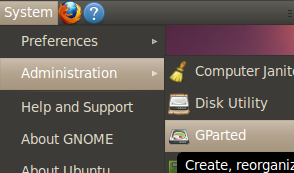

You can go to System > Administration > GParted and enter your password to get it started.

Ah, now I can definitely see it's Ext4 for sure. Under Partition I see it's /dev/sda2, and under Filesystem, I see it's Ext4.
If you have a second physical hard drive (not just another partition), you might have to click on the top-right corner to focus on the second hard drive. (Click on the down-pointing arrow to get the drop-down menu.)
So now I'll create a mount point for that partition:
Next, I want to determine the UUID of my partition.***
lrwxrwxrwx 1 root root 10 2010-04-26 12:00 20bfd80a-a96b-461c-a63d-c96ff8e95872 -> ../../sda1
lrwxrwxrwx 1 root root 10 2010-04-26 19:19 d1d0cf46-958f-4a12-a604-0ac66040648b -> ../../sda2
sudo nano /etc/fstab
Once in there, I should add in this line:
Then I can save (Control-X), confirm (Y), and exit (Enter).
Since we've made changes to the /etc/fstab file, we need to have Ubuntu acknowledge those changes:
Now I need to give it the proper permissions. Let's just assume, for this example, that my username is jessica.
sudo chmod -R 755 /storage
Now the partition is mounted in the /storage folder and is ready for use!
*** Yes, I could just use the name of it (/dev/sda2), but UUID is more precise. It's unlikely that I'll unplug my internal drive, plug in a new internal drive, and then plug back in my original internal drive so that the partition names are reassigned. Still, it's safer to use the exact partition identifier in /etc/fstab.
Last updated 04/29/12 08:41
If you have suggestions or corrections for these tutorials, please post in this Ubuntu Forums thread or leave a comment on my blog.
I will not give help to people posting in the above places. If you require technical support, start a support thread on the Ubuntu Forums. That is the appropriate place to ask for help.